How to trade on IQ Option in Pakistan: from demo to first trade
IQ Option has three kinds of trades: Blitz, Binary and Margin CFD. The first two are options with a fixed expiry, and the third is a CFD with leverage. You can practise all three for free on the $10,000 demo. This guide covers your first trade, how profit and loss are worked out, the chart tools and the basic rules for managing risk.
CFDs and options are high-risk, and you can lose the money you deposit.
What you can trade on IQ Option
The traderoom offers three kinds of trades: Blitz, Binary and Margin CFD. Blitz and Binary are options, and Margin CFD covers forex pairs, stocks, commodities such as gold and oil, indices and crypto.
With an option, you see your payout before you open the trade. The most you can lose is the amount you put in. On a CFD, profit and loss depend on how far the price moves and on the leverage you choose, so the maths works differently. Asset lists and payouts change over time, so check the traderoom before you trade.
Blitz, Binary and CFD compared
| Type | What it is, expiry and payout |
|---|---|
Blitz | Options with very short expiries. On EUR/USD and NZD/USD (OTC) the expiry runs from 30 seconds to 5 minutes, and on gold and US 500 from 1 to 15 minutes. Payouts are around +83% to +87%. |
Binary | Options on whether the price ends above or below the current level at expiry. OTC indices (Dollar, Euro, Pound and AUD Index) run from 15 to more than 60 minutes at +88%. JP 225, Tesla, Amazon and Bitcoin run from 1 to more than 60 minutes at +87%. |
Margin CFD | Leveraged trades on price moves. Unlike an option, there’s no fixed expiry, so you close the trade yourself. Leverage on EUR/USD runs from ×50 to ×1,000, and you can set a stop loss and take profit. |
Your first demo trade, step by step
The demo account comes with a $10,000 virtual balance. When it runs out, you can top it back up with any amount from $10 to $10,000. Demo money can’t be withdrawn, so treat it as a place to practise.
- Press the button below to open the demo traderoom.
- In the trade panel, choose the option type (Blitz or Binary) and an asset, for example EUR/USD.
- Set the expiry, for example 30 seconds or 1 minute on Blitz.
- Enter the amount. Keep it small while you learn.
- Check the payout shown on the panel, for example +86%, and how much you would get back if you win.
- If you think the price will be above the current level at expiry, press the upper button. If you think it will be below, press the lower one.
- Wait for the expiry and check the result.
How profit and loss work on options
On an option, the payout is fixed the moment you open the trade. Say Blitz on EUR/USD (OTC) shows +86% and you put in $10.
- If the price ends on your side at expiry, you make $8.60 and get $18.60 back in total.
- If it ends on the other side, you lose the $10.
Only the price at the moment of expiry counts. The price can sit on your side for most of the trade and still turn at the last second. Then the trade is lost.
The payout also tells you how often you need to be right. At +86%, you have to win about 54 trades out of every 100 just to break even (1 divided by 1.86). At +88%, it’s about 53. This is simple maths and leaves out any other costs.
How CFD trades work
With a CFD, you don’t own the asset. You trade on its price moving up or down. If you think the price will rise, you press Buy, and if you think it will fall, you press Sell.
- Choose a CFD asset, for example EUR/USD.
- Enter the investment, for example $10.
- Set the leverage. Starting low is the safer choice.
- Add a stop loss and take profit if you want them.
- Check the spread and swap shown on the panel, then press Buy or Sell.
For example, a $10 investment at ×100 leverage gives you a $1,000 position. A 0.1% price move then makes or loses $1, which is 10% of your investment. If the price moves 0.5% against you, you lose $5, which is half the investment. Without a stop loss, stop out closes the trade at that point. The example leaves out the spread and swap. Leverage makes profits and losses bigger at the same rate.
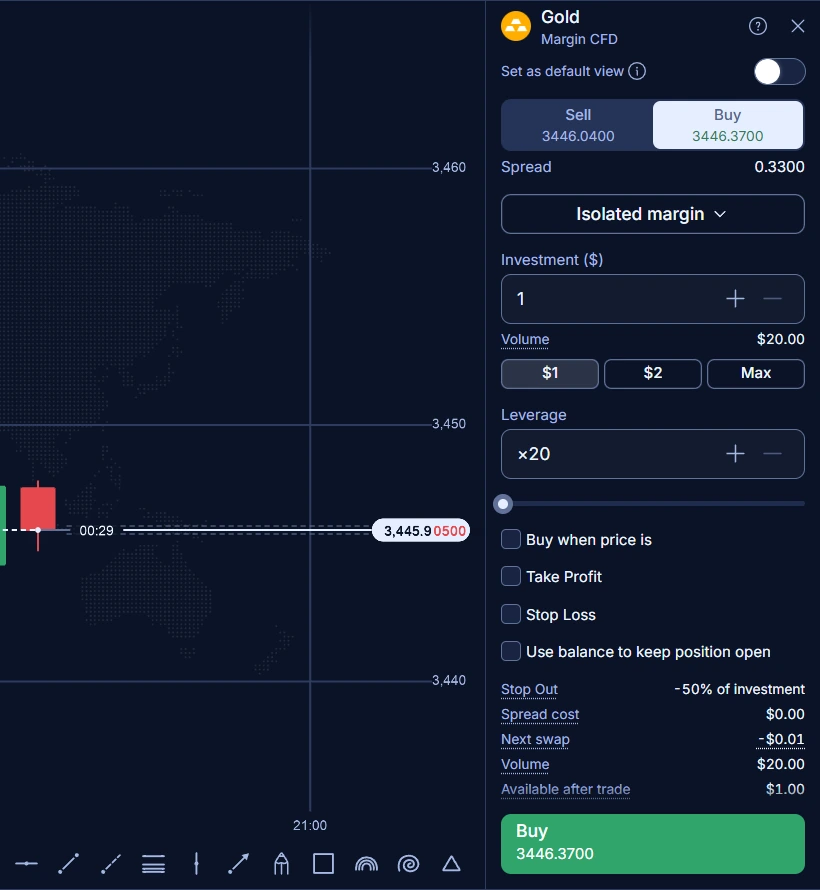
Leverage examples on different CFDs
| Asset | Leverage range |
|---|---|
XAUUSD (gold) | ×20 to ×800 |
BTCUSD perp | ×200 to ×1,000 |
EURUSD | ×50 to ×1,000, spread 0.7 |
US100 | ×20 to ×1,000 |
ETHUSD perp | ×200 to ×500 |
WTI | ×20 to ×600 |
US500 | ×20 to ×1,000 |
Stop loss, take profit and stop out
The tools for managing risk on a CFD sit in the same panel you use to open the trade.
- Stop loss: the trade closes on its own when the price reaches your limit, so the loss stays close to the level you set.
- Take profit: the trade closes on its own when the price reaches your target, and the profit is locked in.
- Buy when price is: you can place an order in advance that opens the trade only when the price reaches a set level.
- Isolated margin: each trade has its own margin, kept apart from your other trades.
- Stop out: the trade closes automatically once it has lost 50% of the investment.
- Spread and swap: both are shown before you trade, so you know the cost before you open a position.
Chart tools and indicators
The chart’s indicators are sorted into seven groups: popular, momentum, trend, volatility, moving averages, volume and other. The drawing tools include arrows, horizontal and vertical lines, a line tool, a pencil, trend lines, Fibonacci tools (arcs, lines and spiral), rectangles and triangles. Chart times show PKT (UTC+5), Pakistan time.
One or two tools are enough at the start. No indicator can tell you for sure where the price will go, and two indicators that point in opposite directions make the decision harder. Try tools on the demo to find out which ones help you.
Basic rules for managing risk
- Don’t risk more than 1 or 2% of your balance on a single trade. On a PRs 30,000 balance, that’s PRs 300 to 600.
- Set a stop loss before you open a CFD trade.
- Start with low leverage and raise it slowly once you’re used to it.
- Don’t make your trades bigger to win back money you’ve lost.
- Move to a real account only after a few weeks of following your own rules on the demo.
- Never trade with money you need for household expenses.
These rules keep losses small, but none of them guarantees a profit.
Common beginner mistakes
- Starting on a real account without practising on the demo first.
- Opening a trade because of the payout percentage without checking how much you lose if you’re wrong.
- Placing lots of trades on very short expiries.
- Picking the highest leverage on the very first trades.
- Opening a CFD without a stop loss.
- Following signals or groups that promise “guaranteed profit”.
- Raising the amount on the next trade to make up for a loss.
Trading in the app
The traderoom runs in the Android, iPhone, Windows and macOS apps and in the browser. Log in with the same email and password and you get the same account everywhere. On a phone, get used to small trades first. If you use a lot of chart tools, a computer’s bigger screen makes it easier. Our download guide explains which version to get and how to install it. If you get stuck at login, see our login guide.
Deposits and promo codes for real trading
The minimum deposit for a real account is PRs 3,000 on every method. Easypaisa and JazzCash deposits ask for the wallet’s phone number and your CNIC. Choose PKR as your account currency at the first deposit, because it can’t be changed afterwards. Our deposit and withdrawal guide has the steps and timings for each method.
A promo code entered at deposit adds a bonus. Bonus money needs a set trading volume before it can be withdrawn, and the terms differ from code to code. Until then the bonus stays active, and withdrawals are blocked. Our promo codes page lists the current codes and their terms.
Try your first trade on the demo
The demo needs no deposit. With $10,000 in virtual money, you can try Blitz, Binary and CFD trades, and you can top the balance up again when it runs out. For the full picture of the platform, read our IQ Option Pakistan review.
CFDs and options are high-risk, and you can lose the money you deposit.
FAQ
How do I trade on IQ Option?
Open the demo traderoom, pick an asset and set the expiry and amount. Check the payout percentage, then press the upper or lower button depending on where you think the price will be at expiry. On a CFD, you set leverage and a stop loss instead of an expiry and press Buy or Sell. The steps are explained in detail earlier on this page.
How much money do I need to start trading?
The demo is free and needs no deposit. To trade with real money, the minimum deposit from Pakistan is PRs 3,000. The trade panel shows the smallest amount you can enter for each asset.
Does the demo account need real money?
No, the demo needs no deposit. The balance is $10,000 in virtual money, and when it runs out you can top it up with any amount from $10 to $10,000. Demo money can’t be withdrawn.
What's the difference between Blitz, Binary and CFD?
Blitz and Binary are options. The result depends on where the price is at expiry, and the payout is shown before you trade. Blitz has very short expiries, for example 30 seconds to 5 minutes on EUR/USD (OTC). A CFD has no fixed expiry. You can use leverage and a stop loss, and profit or loss moves with the price.
What does leverage do on a CFD?
Leverage multiplies the size of your position. $10 at ×50 trades like $500, so both profit and loss are worked out on $500. Start with low leverage until you know how fast a position can move.
What is stop out on a CFD?
Stop out closes a trade automatically once it has lost 50% of the investment. If you set your own stop loss, you can limit the loss earlier than that.
Can I lose an option even if the price moved my way?
Yes. On an option, only the price at the moment of expiry counts. If the price is on your side for most of the trade but turns at the end, you lose.
Can I make the same trades in the mobile app?
Yes. The app gives you the same account, with both the demo and the real balance. There are apps for Android, iPhone, Windows and macOS. The install steps are in our download guide.
Does IQ Option charge commission on trades?
There’s no commission on trades. A CFD costs the spread when you open it and a swap for each night you hold it. A conversion fee applies if you pay in a currency other than your account currency.
Can trading guarantee a profit?
No. No method, indicator or signal guarantees a profit. On an option you can lose the whole amount of the trade, and on a CFD leverage makes losses grow fast. Practise on the demo, and only put in amounts you can afford to lose.
Risk warning
IQ Option’s financial instruments carry a high level of risk, and you can lose the money you invest. Trading CFDs and options carries a high risk of losing money, so make sure you understand how CFDs work before you invest. IQ Option is not registered with SECP or any other regulator in Pakistan. This page is an independent review, not financial advice. The author may earn a commission through affiliate links.